
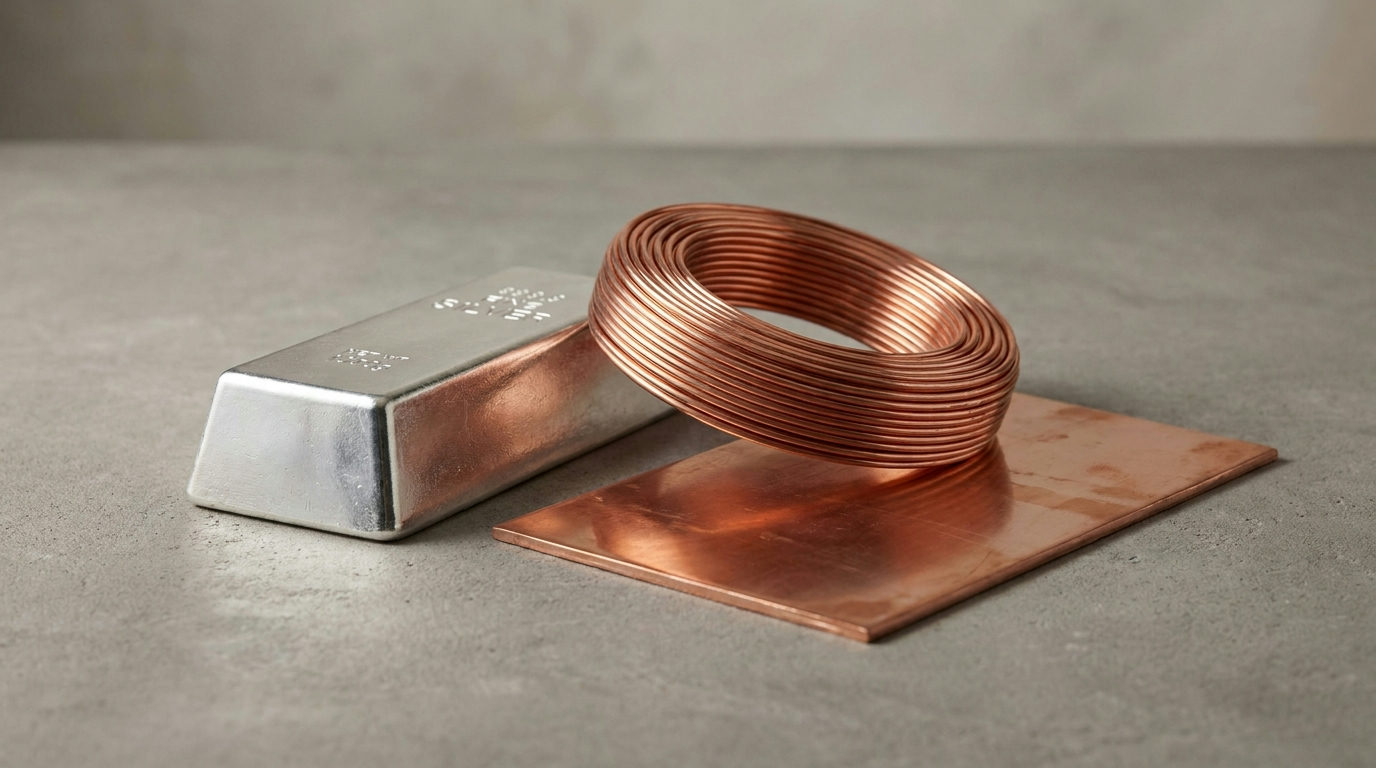
Silver and copper are both excellent conductors of electricity, and both are vital to electronics, power grids and clean energy. Yet one is a precious metal and the other a base metal, with very different prices and markets. Comparing silver vs copper helps explain why industry sometimes swaps one for the other, and why their markets are more closely linked than they first appear.
Silver vs copper at a glance
| Feature | Silver | Copper |
|---|---|---|
| Metal type | Precious metal | Base (industrial) metal |
| Electrical conductivity | Highest of all metals | Very high, just below silver |
| Price per unit | Far higher | Far lower |
| Main demand | Industry, plus jewellery and investment | Mostly industry and construction |
| Investment role | Widely held as coins, bars and funds | Mainly traded as an industrial commodity |
| Price unit | US dollars per troy ounce | Usually per pound or per metric ton |
The US Geological Survey notes that silver has the highest electrical and thermal conductivity of any metal. Copper comes close, which is why it is the workhorse of electrical wiring.
Why industry substitutes copper for silver
Because copper performs almost as well at a fraction of the cost, manufacturers often try to replace silver with copper where they can. Solar is the clearest example. According to the Silver Institute’s World Silver Survey 2026, solar demand for silver fell 6% in 2025 because of thrifting and substitution. Copper-based alternatives are one of the main substitutes. We explain this in our guide to silver solar panel demand.
However, substitution has limits. In some uses, silver’s slightly better conductivity, corrosion resistance or bonding properties still matter. So the balance depends on price: the more expensive silver becomes relative to copper, the stronger the push to switch.
How the two markets are linked through mining
Copper and silver are also linked on the supply side. A significant share of silver comes as a by-product of copper mining. According to the survey summary, much of the growth in silver mine output in 2025 came from higher by-product production at copper operations in Peru.
This creates an unusual relationship. If copper demand rises and copper mines expand, silver supply can rise too, even if silver demand has not changed. Likewise, copper mine cuts can reduce silver supply. Our guide to by-product silver covers this in more detail.
Silver vs copper as economic signals
Copper is often watched as a gauge of global industrial activity, because it is used so widely in construction and manufacturing. Silver is harder to read. It responds to industrial activity too, but also to investment demand, the US dollar and the gold price. As a result, silver can diverge from copper when investors are buying or selling precious metals. For more on those drivers, see our guide to what drives silver prices.
Frequently asked questions
Is silver a better conductor than copper?
Yes. Silver has the highest electrical conductivity of any metal, according to the USGS, with copper close behind.
Why is copper used more than silver in wiring?
Because copper conducts almost as well and costs far less, which makes it practical for large volumes.
Can copper replace silver?
In some uses, such as parts of solar cell production, it can partly replace silver. In others, silver’s properties are still preferred.
Are silver and copper prices linked?
Partly. Both respond to industrial activity, and copper mining produces silver as a by-product. However, silver also responds to investment demand, so the two can diverge.
Sources
- USGS: Silver Statistics and Information
- SilverTrade: The Silver Institute releases 2026 World Silver Survey (April 15, 2026)
- Mexico Business News: World Silver Survey 2026 (May 18, 2026)
This article is general information, not financial advice. Past relationships between markets do not guarantee future ones.
Written and reviewed by the SilverPriceCharts.com editorial team. Sources are linked above.